Marcus Aurelius vs Epictetus: Two Approaches to Stoic Control
Epictetus gives a disciplined account of what belongs to our agency; Marcus Aurelius shows a practitioner repeatedly applying related Stoic ideas under pressure.
On this page
Epictetus and Marcus Aurelius do not offer rival theories of control. They belong to the same Stoic tradition, and Marcus was influenced by Epictetus. The important difference is one of voice and use: Epictetus teaches students how to identify and train their agency, while Marcus records an advanced practitioner reminding himself how to judge, act, and cooperate under the pressures of public life.
Epictetus begins with what belongs to us
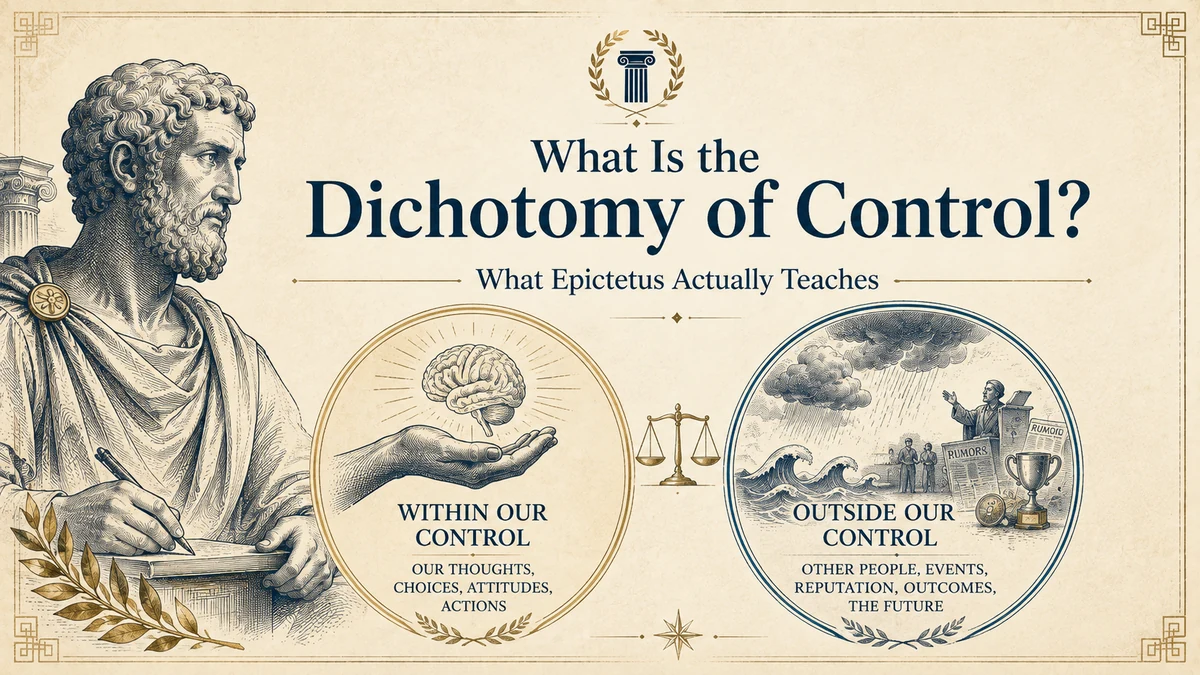
The opening of Epictetus’s Handbook distinguishes what is “up to us” from what is not. The first group concerns judgments, impulses, desires, aversions, and actions understood through the faculty Epictetus calls prohairesis, often translated as choice, volition, or moral purpose. The second includes body, property, reputation, and office insofar as their final condition depends on causes beyond our agency.
This is often summarized as “control what you can and accept what you cannot.” The summary is memorable but incomplete.
Epictetus is not saying that external matters are irrelevant or that people should become passive. He is asking where moral freedom is located. You can prepare carefully for an interview, speak truthfully, and choose how to respond. You cannot command the interviewer’s judgment or the final decision. The outcome matters in planning, but it does not become the measure of character merely because you want it.
The distinction is therefore ethical before it is motivational. It protects the quality of one’s choices from dependence on unstable results.
Marcus Aurelius turns doctrine into daily reminders
The Meditations presents a different literary situation. Marcus writes to himself. He is not constructing a systematic beginner’s course, and he does not repeatedly name a doctrine called the dichotomy of control. Instead, he practices related Stoic distinctions in short reminders.
At the beginning of Book 2, he prepares to encounter difficult people while recalling that human beings are related participants in a shared rational order. Elsewhere he reminds himself that disturbance depends on judgments, that present action should serve justice, and that other people’s errors do not force him to imitate them.
The tone is practical because the writer already knows the principles and is trying to use them. The question is less “What does Stoicism teach?” and more “Can I bring my judgment back into alignment now?”
That makes Marcus attractive to modern readers. His notes resemble private exercises: reframe an impression, remember a duty, reduce resentment, and return attention to the action immediately available.
Teacher and practitioner
The contrast can be stated without inventing opposition.
Epictetus emphasizes training choice
His classroom language repeatedly asks students to identify what can be hindered, what genuinely belongs to them, and how impressions become judgments. He warns against attaching freedom to reputation, status, or bodily security because those goods remain vulnerable to others and to circumstance.
Marcus emphasizes rehearsal
As emperor, Marcus writes amid administrative burdens, conflict, illness, and difficult relationships. His recurring task is to preserve justice and rational cooperation without allowing anger, praise, fatigue, or fear to dictate character.
Epictetus explains the architecture
The Discourses and Handbook provide conceptual distinctions, arguments, challenges, and exercises.
Marcus demonstrates repetition
The Meditations shows that understanding a principle once is not enough. Practice requires returning to it whenever an impression becomes emotionally compelling.
Control does not mean domination
Modern language makes control sound like the power to force an outcome. Stoic agency is almost the reverse. It begins when a person stops treating the world as if it must obey desire before good action is possible.
For Epictetus, freedom requires refusing to place one’s moral condition in another person’s hands. For Marcus, the consequence is to act well within the social role and circumstances one occupies.
Neither philosopher advises indifference to injustice. Stoic ethics treats human beings as rational and social. The fact that a political or professional result is not fully up to one person does not mean that person should avoid speaking, organizing, protecting others, or accepting risk. It means committed action must be distinguished from the fantasy of guaranteed success.
Practical or modern example
Suppose a manager presents your work as their own.
An oversimplified use of Stoicism says, “Their behavior is outside your control, so ignore it.” That conclusion does not follow.
An Epictetan analysis separates the elements:
- You cannot directly command the manager’s honesty.
- You can document your work.
- You can choose whether and how to address the issue.
- You can seek formal review or leave the environment.
- You cannot guarantee how leadership will respond.
A Marcus-inspired exercise adds questions:
- Can you respond without becoming unjust in return?
- What action serves your role and the wider team?
- Are anger and fear supplying information, or also exaggerating the situation?
- What would firmness without spite look like?
The Stoic response may include confrontation, escalation, or departure. Acceptance means recognizing the actual field of action, not approving wrongdoing.
Common misreadings
One mistake is treating Epictetus as a teacher of emotional numbness. His target is not feeling as such but the judgments and attachments that make freedom depend on unstable externals.
Another is reading Marcus as a collection of productivity slogans. His reminders belong to a larger Stoic account of virtue, social responsibility, nature, judgment, and desire.
A third is making their social positions into a simplistic paradox: an emperor and a formerly enslaved teacher saying the same thing. Biography matters, but philosophical comparison must also attend to genre, arguments, and purpose.
Questions to explore
- Which outcomes do you mistakenly treat as extensions of your will?
- What action remains yours when success cannot be guaranteed?
- Does accepting uncertainty weaken commitment, or clarify it?
- When does anger reveal injustice, and when does it add an inaccurate judgment?
- Which practice do you need more: Epictetus’s distinction or Marcus’s repetition?
How PhiloMind AI approaches this topic
PhiloMind AI provides separate source-grounded experiences inspired by Marcus Aurelius and Epictetus. Their responses should not be flattened into one generic Stoic voice. The Epictetus interpretation can emphasize agency, impressions, and disciplined choice; the Marcus interpretation can emphasize reflective practice, social duty, and present conduct.
Debate Mode is now live for currently debate-ready philosophers. This Marcus Aurelius–Epictetus article remains an editorial comparison; Marcus Aurelius is not currently enabled for Debate Mode. You can explore all available philosophers, explore the Stoic AI experience, and view the live debate area.
Sources and further reading
The structured source records accompanying this article identify the primary Stoic texts and scholarly references used during drafting. They require human philosophical review before publication.
On this page
Sources
- The Encheiridion, or Manual by EpictetusWork: Enchiridion. Locator: Sections 1, 5, 8, and 14. Source host: Project Gutenberg.
- The Discourses of Epictetus by Epictetus, as recorded by ArrianWork: Discourses. Locator: I.1; I.28; III.2. Source host: Perseus Digital Library.
- Meditations by Marcus AureliusLocator: I.7; II.1; II.5; IV.3; VI.52; XI.18. Source host: MIT Internet Classics Archive.
- Marcus Aurelius by Rachana KamtekarWork: Stanford Encyclopedia of Philosophy. Locator: §§1–4, especially the discussion of Meditations, deliberation, and ethical practice. Publisher: Metaphysics Research Lab, Stanford University. Published 2025.
- Epictetus by Margaret GraverWork: Stanford Encyclopedia of Philosophy. Locator: §§1, 4.1, 4.3–4.7, 5, and 6. Publisher: Metaphysics Research Lab, Stanford University. Published 2022.
AI assisted with research organization and drafting. The article requires human editorial and philosophical source review before publication.
PhiloMind AI provides source-grounded AI philosopher conversations and live Debate Mode between debate-ready philosophers.