What Is the Dichotomy of Control? Epictetus Explained With Real-Life Examples
The dichotomy of control distinguishes what is up to us from what is not. Epictetus uses it to locate freedom in judgment, choice, and action—not to teach indifference or passivity.
On this page
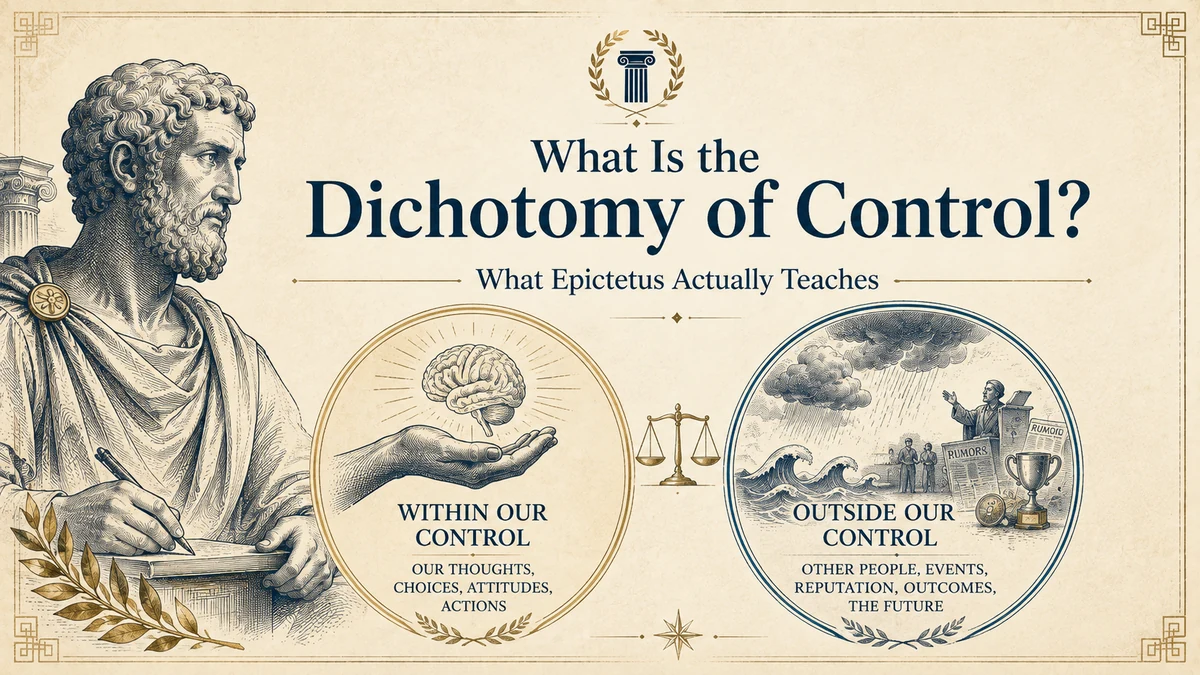
The dichotomy of control is the modern name for Epictetus’s distinction between what is up to us and what is not. What is up to us concerns our use of judgments, impulses, desires, aversions, and choices. What is not fully up to us includes body, property, reputation, office, other people’s responses, and final outcomes. The teaching does not say that external events are unimportant. It asks where moral agency and freedom are located.
Why “up to us” is more precise than “under our control”
The word control often suggests the power to produce a result whenever we choose. Epictetus’s distinction is narrower.
You can prepare a presentation, verify evidence, practice delivery, and answer questions honestly. You cannot command the audience’s attention, prevent every technical failure, or guarantee approval. Your work influences the result, but influence is not the same as ownership of the result.
The distinction therefore protects good choice from dependence on circumstances. An action can be careful and reasonable even when it fails. An action can also succeed while being dishonest or reckless. Outcome alone does not settle the quality of agency.
What belongs to choice
In the Discourses, Epictetus gives special importance to prohairesis, translated in different editions as choice, volition, or moral purpose. The term should not be simplified into a claim that every thought or feeling is instantly controllable.
An impression may arrive without permission: “They rejected my application.” A judgment then develops: “This proves I am incapable.” Epictetan practice focuses on how the impression is examined and whether assent is given to the additional conclusion.
Useful questions include:
- What exactly happened?
- Which sentence is a fact and which is an interpretation?
- Does the interpretation logically follow?
- Which action is still available?
- Am I allowing another person’s decision to define my character?
Training does not make reactions disappear on command. It develops a more deliberate relationship to them.
External things can matter without being the moral good
Stoic ethics calls health, money, reputation, and office “indifferents” with respect to virtue and flourishing. The term is easy to misunderstand. It does not mean that health and illness are normally interchangeable choices or that injustice should be ignored.
Health is ordinarily preferred to illness. Safety is ordinarily preferred to danger. Fair treatment is ordinarily preferred to exploitation. Stoics can plan, seek help, protect others, and work to change institutions.
The restriction is that these conditions do not become good in the same unconditional sense as excellent character. Wealth can be used generously or corruptly. Reputation can reward integrity or manipulation. Losing an external good does not by itself make a person unjust, and gaining it does not make a person virtuous.
Acceptance is not approval
Acceptance begins with factual recognition. If a decision has already been made, pretending it has not happened wastes attention. Recognizing that you cannot rewrite the past is not the same as approving the decision.
The next question is practical: what response is up to you now?
Depending on the case, the answer may include an appeal, confrontation, documentation, boundary, apology, change of plan, or departure. Stoicism removes the demand for guaranteed success; it does not remove responsibility for action.
Real-life example 1: waiting for a reply
You have completed an interview and no response arrives.
Up to you: sending accurate information, following up once at an appropriate time, continuing other applications, and deciding how often to check messages.
Not up to you alone: the number of candidates, internal delays, the evaluator’s preferences, and the final decision.
The exercise redirects effort. It does not require pretending the result has no consequences.
Real-life example 2: criticism from a manager
A manager says your work is not ready.
Up to you: asking for specific examples, reviewing the evidence, correcting genuine weaknesses, and documenting a pattern if the feedback is unfair.
Not up to you alone: the manager’s personality, their private opinion, and whether they communicate respectfully.
The distinction helps you avoid two errors: rejecting useful criticism because the delivery was unpleasant, or accepting an unfair verdict because it came from authority.
Real-life example 3: another person is angry with you
You can explain, apologize, repair, or set a boundary. You cannot guarantee forgiveness or agreement.
If you make reconciliation the only acceptable result, your conduct becomes dependent on another will. If you refuse all responsibility because the reaction is external, you misuse Stoicism in the opposite direction. The relevant question is whether you have acted honestly and proportionately with the information available.
Real-life example 4: a project fails
A project can fail despite good planning because many causes shape results. The control distinction asks for a process review rather than a global self-condemnation.
- Did you use the available evidence?
- Did you communicate risks?
- Did you revise when new facts appeared?
- Were there factors no participant could command?
- What remains repairable now?
The result supplies information, but it is not the only measure of the choice.
Real-life example 5: a public event or political outcome
Citizens influence public outcomes through voting, organizing, speaking, contributing, and protecting institutions. No one citizen commands the final result.
The Stoic conclusion is not withdrawal. It is committed action without the belief that moral worth depends on total control of a complex system. Justice remains a reason to act even when success is uncertain.
Three common mistakes
Mistake 1: “Ignore everything you cannot control”
You must attend to many things you do not control: weather, market conditions, another person’s needs, illness, and political institutions. The issue is not attention. It is the attempt to make your character and stability conditional on commanding those things.
Mistake 2: “Your mind is completely controllable”
Impressions and initial reactions can occur without deliberate choice. Stoic responsibility concerns how impressions are handled, endorsed, and converted into action. The philosophy describes training, not an instant switch.
Mistake 3: “Failure proves bad judgment”
A reasonable decision can fail. A reckless decision can succeed by luck. Outcomes matter for learning, but retrospective judgment must consider the information and choices available at the time.
Practical or modern example
Suppose a landlord, university, employer, or public agency delays a decision that affects your next year.
Write four lines:
- Fact: what has happened without prediction.
- Judgment: what you are currently adding to the fact.
- Agency: the actions and standards still yours.
- External result: the part dependent on other people or circumstances.
Then choose one next action. It may be following up, preparing an alternative, seeking qualified advice, or deliberately waiting until a reasonable date. The point is not constant activity. It is replacing compulsive reaction with chosen action.
Questions to explore
- Which result have you turned into a verdict on your worth?
- Are you confusing influence with guaranteed command?
- Which judgment is intensifying the event?
- What action remains possible now?
- Are you using acceptance to avoid a duty?
- What would count as acting well even if the result disappoints you?
How PhiloMind AI approaches this topic
PhiloMind AI’s Epictetus experience is an AI-generated interpretation shaped by approved sources about judgment, impressions, volition, desire, aversion, and freedom. It should not reduce the philosophy to “stop caring” or claim that users can instantly control every emotion.
You can explore the Stoic AI experience or browse the philosopher directory. Debate Mode is now live for debate-ready philosophers.
Sources and further reading
The structured source records accompanying this article identify the George Long source texts and scholarly references used during drafting. The real-life examples are modern editorial applications and require human philosophical review before publication.
On this page
Sources
- The Encheiridion, or Manual by EpictetusWork: Enchiridion. Locator: Sections 1, 5, 8, 14, and 20. Source host: Project Gutenberg.
- The Discourses of Epictetus by Epictetus, as recorded by ArrianWork: Discourses. Locator: I.1; I.17; I.28; II.5; III.2. Source host: Perseus Digital Library.
- Epictetus by Margaret GraverWork: Stanford Encyclopedia of Philosophy. Locator: §§1, 3, 4.1, 4.3–4.7, and 5. Publisher: Metaphysics Research Lab, Stanford University. Published 2022.
- Stoicism by Marion Durand, Simon Shogry, and Dirk BaltzlyWork: Stanford Encyclopedia of Philosophy. Locator: §§1, 2.9, and 4.1–4.7, especially §4.7 on passions. Publisher: Metaphysics Research Lab, Stanford University. Published 2023.
AI assisted with research organization and drafting. The article requires human editorial and philosophical source review before publication.
PhiloMind AI provides source-grounded AI philosopher conversations and live Debate Mode between debate-ready philosophers.