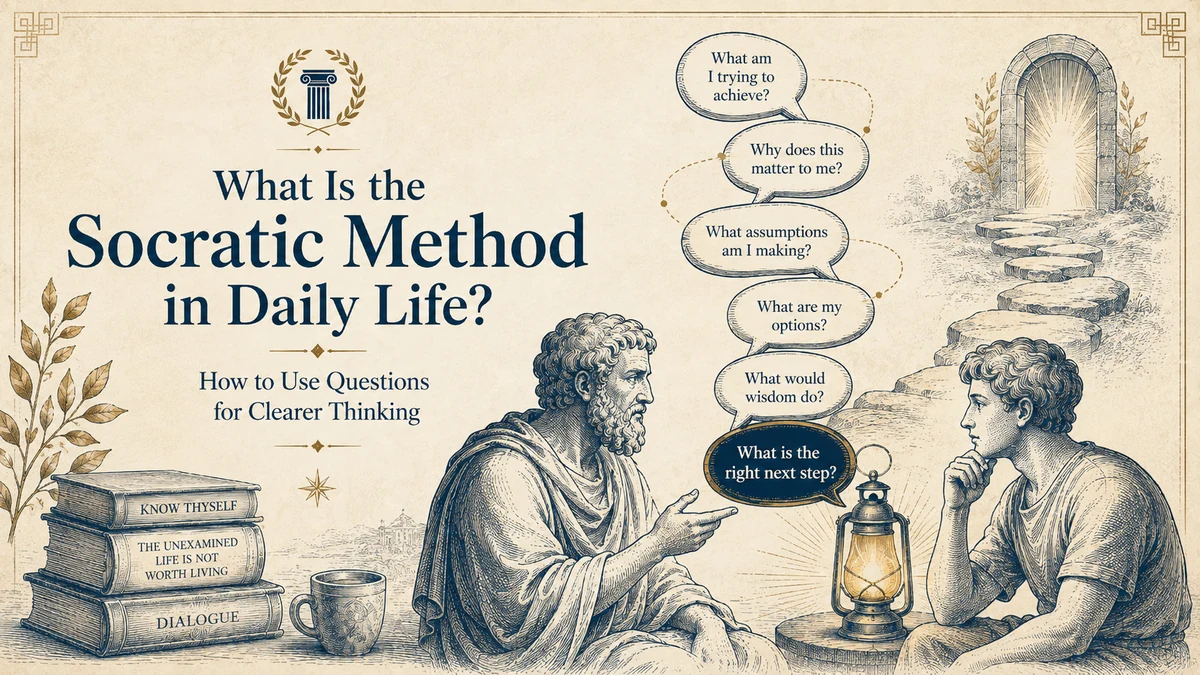
What Is the Socratic Method and How Can You Use It in Daily Life?
The Socratic method is a family of question-and-answer practices that clarify claims, test reasons, reveal contradictions, and replace unsupported certainty with better inquiry.
On this page
The Socratic method is a family of question-and-answer practices used to examine claims. It clarifies important terms, asks for reasons, uncovers hidden assumptions, tests implications, searches for counterexamples, and revises a position when its commitments conflict. It is not one official five-step formula written by Socrates, and it is not simply asking many questions.
Where the method comes from
Socrates left no writings. The familiar picture of Socratic questioning comes mainly through literary witnesses, especially Plato. Because these accounts differ and have their own philosophical purposes, readers should distinguish Plato’s represented Socrates from certainty about the historical person.
In Plato’s shorter ethical dialogues, an interlocutor often begins with confidence about courage, temperance, piety, or virtue. Socrates asks questions that reveal the proposed definition is too narrow, too broad, circular, or inconsistent with other beliefs the speaker accepts.
The result is sometimes aporia: perplexity or an impasse. That is not necessarily failure. Discovering that a confident answer lacks support can be the beginning of more honest inquiry.
The six functions of Socratic questioning
The following sequence is a modern practical synthesis, not a canonical ancient checklist.
1. State one examinable claim
A topic such as “career,” “loyalty,” or “success” is too broad. Turn it into a sentence that could be true or false.
- “A successful career requires public recognition.”
- “A loyal friend should always take my side.”
- “Changing my mind publicly makes me weak.”
2. Define the central term
Ask what success, loyalty, weakness, fairness, courage, or responsibility means in the claim.
A useful definition must cover more than one favored example. If courage means “remaining in danger,” it may classify reckless refusal to retreat as courageous and careful rescue as cowardly. The definition needs revision.
3. Ask for the reason
Why do you believe the claim?
- Is the reason based on evidence?
- Is it inherited from family, workplace, or culture?
- Is it a prediction based on one experience?
- Would the same reason persuade you in another person’s case?
4. Expose the hidden assumption
Arguments often contain an unstated bridge.
“Declining the promotion proves I lack ambition” assumes that ambition is measured by accepting higher status. Once visible, the assumption can be tested separately.
5. Test implications and counterexamples
Ask what else must follow if the claim is true. Then search for a case that fits the definition but produces a conclusion you reject.
If loyalty means agreement, was a friend disloyal when they stopped you from making a serious mistake? If not, loyalty needs a richer definition.
6. Revise the claim
Socratic examination is not a contest in which the first sentence must be defended at all costs. A more precise conclusion is progress.
“A successful career requires recognition” may become: “Recognition can provide evidence that work affects others, but it is neither sufficient nor always necessary for a successful career.”
Daily-life example 1: “I cannot say no”
Claim: “Saying no to a request makes me selfish.”
Questions:
- What is selfishness?
- Does every refusal count as selfish?
- Can accepting every request harm existing responsibilities?
- Would you call another person selfish for protecting a necessary limit?
- Which facts distinguish generosity from overcommitment?
The purpose is not to force refusal. It is to replace an absolute rule with a defensible standard.
Daily-life example 2: “If I change my mind, I lose credibility”
Questions:
- Is credibility based on consistency or responsiveness to evidence?
- Do you respect anyone who publicly corrected an error?
- Would refusing better evidence increase credibility?
- Are you predicting everyone’s reaction or fearing some reactions?
- What would responsible correction look like?
The revised claim might distinguish careless inconsistency from principled revision.
Daily-life example 3: “My disagreement means the relationship is failing”
Questions:
- What kind of disagreement?
- Does a healthy relationship require identical judgments?
- Which disagreements reveal incompatible values, and which reveal different information?
- Is the problem disagreement itself or the way it is handled?
- What evidence would distinguish temporary conflict from structural failure?
Daily-life example 4: “This mistake ruined everything”
Questions:
- What exactly has been damaged?
- Which consequences are permanent and which are repairable?
- Does “everything” include skills or relationships that remain?
- What standard are you using to judge the entire project?
- What action would follow if the conclusion were narrower?
How to use the method without becoming exhausting
Socratic questioning can become unhelpful when every statement triggers interrogation. Good use requires consent, purpose, and proportion.
- Ask whether the other person wants exploration or simply wants to be heard.
- Explain why a question matters.
- Summarize progress instead of producing an endless chain.
- Do not use questions to hide an accusation.
- Allow the original view to survive if it withstands examination.
- Stop when the conversation lacks the facts needed for further reasoning.
Socratic dialogue is not automatic neutrality
Questions can manipulate. A questioner may choose only examples that point toward a desired conclusion or treat uncertainty as evidence for the questioner’s own view.
A fair examination makes assumptions on both sides visible and permits the user to challenge the questions themselves. “What would show that this question rests on a false assumption?” is often a useful safeguard.
Practical or modern example
You are deciding whether to accept a new job.
Begin with one claim:
I should accept because turning down a higher salary would be irrational.
Then examine:
- What does irrational mean here?
- Is salary the only relevant good?
- Which responsibilities are affected?
- What risks and opportunities are uncertain?
- Would the same rule apply if the role harmed health, family, or integrity?
- Which missing fact would change the decision?
- What revised principle can guide the choice?
The method does not choose the job. It improves the structure of the decision.
Questions to explore
- Which word in your current belief remains undefined?
- What reason supports the claim?
- Which assumption connects the reason to the conclusion?
- What counterexample would most threaten the definition?
- Which two beliefs of yours are in tension?
- What evidence would justify revision?
- What remains unknown after careful questioning?
How PhiloMind AI approaches this topic
PhiloMind AI’s Socrates experience is an AI-generated interpretation shaped by approved source passages and the historical limits of the evidence. It is designed to clarify definitions, test reasons, identify contradictions, and return the conversation to action and character. It does not claim to be the historical Socrates.
You can explore Socratic AI or browse all current philosophers. Debate Mode is now live for debate-ready philosophers.
Sources and further reading
The structured source records accompanying this article identify the Platonic passages and scholarly references used to distinguish ancient evidence from modern practical synthesis. Human source review remains required before publication.
On this page
Sources
- Apology by PlatoLocator: 20c–23c; 37e–38a. Source host: Project Gutenberg.
- Laches by PlatoLocator: 190d–193d. Source host: Project Gutenberg.
- Meno by PlatoLocator: 70a–80d. Source host: Project Gutenberg.
- Socrates by Debra Nails and S. Sara MonosonWork: Stanford Encyclopedia of Philosophy. Locator: Introduction and §§1–2, especially the Socratic problem and ancient sources. Publisher: Metaphysics Research Lab, Stanford University. Published 2026.
- Plato’s Shorter Ethical Works by Paul WoodruffWork: Stanford Encyclopedia of Philosophy. Locator: §§1–3, especially §2 on elenchus and dialogue-specific discussions of definition and aporia. Publisher: Metaphysics Research Lab, Stanford University. Published 2024.
AI assisted with research organization and drafting. The article requires human editorial and philosophical source review before publication.
PhiloMind AI provides source-grounded AI philosopher conversations and live Debate Mode between debate-ready philosophers.