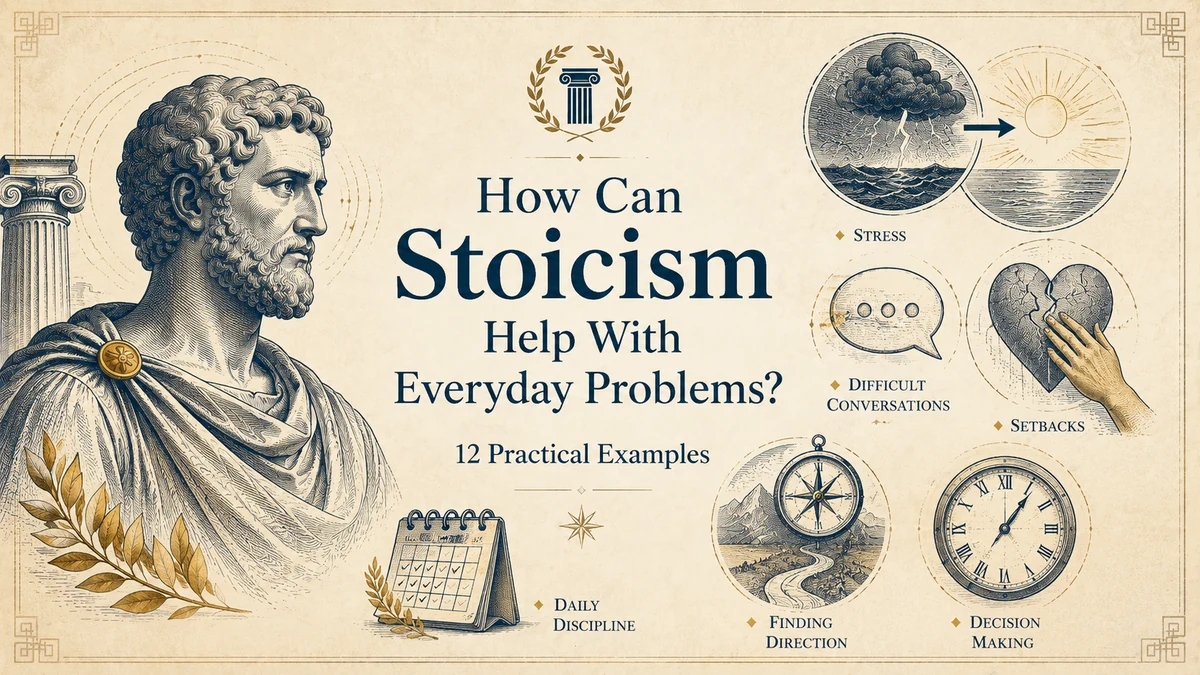
How Can Stoicism Help With Everyday Problems? 12 Practical Examples
Stoicism does not remove ordinary problems or guarantee calm. It offers a disciplined way to separate events from judgments, identify the action still available, and measure success by character as well as outcome.
On this page
Stoicism can help with everyday problems by separating what happened from the judgment added to it, clarifying which part of the situation still belongs to your agency, and directing attention toward the next just and reasonable action. It does not promise control over outcomes, emotional numbness, or freedom from hardship. Its practical value is a more disciplined way of responding when life does not follow your preferences.
What practical Stoicism is trying to change
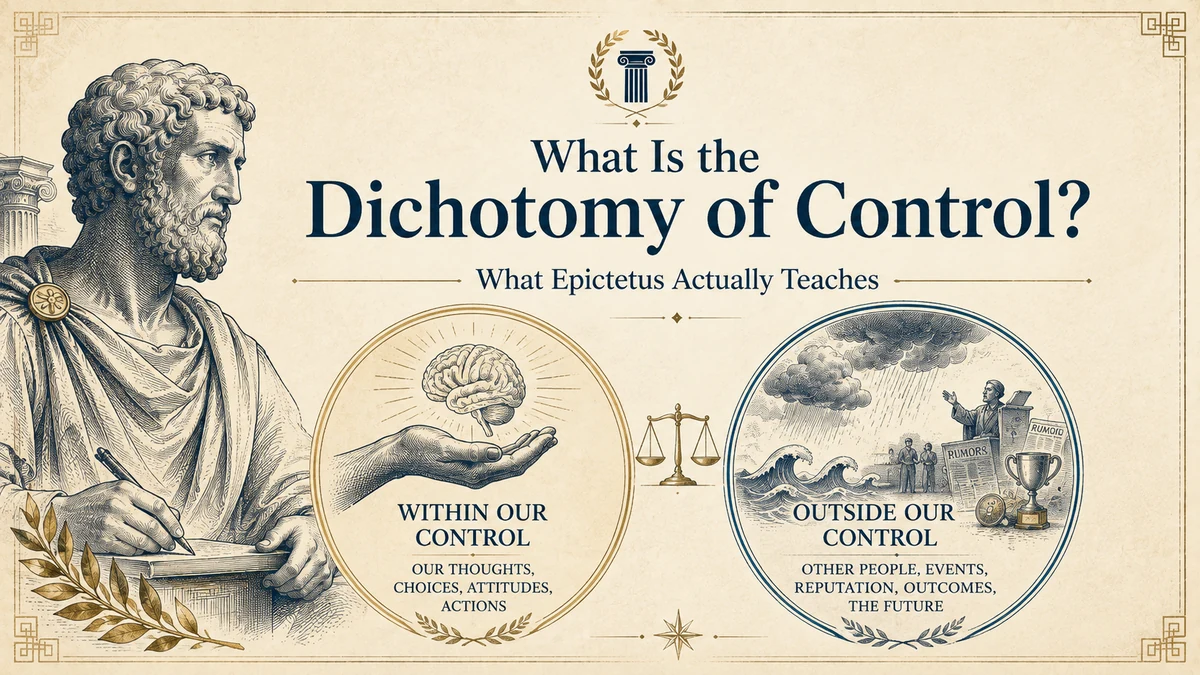
Epictetus begins with a distinction between what is up to us and what is not. Judgments, choices, aims, and the use we make of impressions belong to the sphere of agency in a way that reputation, office, possessions, other people’s decisions, and final outcomes do not. Marcus Aurelius repeatedly turns related Stoic principles into reminders about present action, social duty, mortality, and the quality of his own judgment.
That framework changes the question from “How do I make this problem disappear?” to three more precise questions:
- What are the facts before I add an interpretation?
- Which choices and actions are genuinely mine now?
- Which virtue—such as justice, courage, moderation, or practical wisdom—should guide the response?
The following examples are modern applications. They are not claims about what either philosopher would literally say word for word.
1. Waiting for a decision you cannot force
You have submitted an application, proposal, or request and keep checking for a reply. The decision matters, but repeated checking does not create authority over the decision-maker.
A Stoic inventory separates accurate preparation, a reasonable follow-up, and contingency planning from the final answer and timing. The practice is not pretending the outcome is unimportant. It is refusing to let uncertainty consume every available hour.
2. Receiving criticism that feels personal
Criticism contains at least two layers: what was said and what you conclude it means about you. Some criticism is fair, some is mistaken, and some is delivered badly.
The Stoic move is to examine the content before defending your identity. Is there evidence you can use? Is the criticism outside the speaker’s expertise? Does a hostile tone make the factual part false? Your task is not to control the speaker’s opinion but to decide what deserves correction, learning, or dismissal.
3. Dealing with a difficult coworker
Marcus Aurelius begins Book 2 by preparing himself to meet ungrateful, arrogant, and unsocial people while remembering that human beings are made for cooperation. This is not permission for misconduct. It is preparation against surprise and retaliatory imitation.
In practice, you can document behavior, state boundaries, clarify responsibilities, or escalate a serious issue without adopting the same dishonesty or hostility you oppose.
4. Recovering from a mistake
A mistake can produce the judgment “I am a failure,” which turns one action into a total identity. Stoicism asks for a narrower account.
What exactly was mistaken? Which information was missing? Was the process careless, or was the result simply uncertain? What repair is possible? Regret can become useful when it directs attention toward correction. Endless self-condemnation often avoids the more demanding work of changing a habit.
5. Feeling overwhelmed by a long task list
Overwhelm frequently combines many future actions into one imagined burden. Marcus repeatedly returns attention to the present act and the purpose guiding it.
A practical response is to choose one necessary action, define what “done for now” means, and perform it with care. Stoicism does not make all obligations equal. It asks whether each action is necessary, socially responsible, and proportionate to the time available.
6. Being ignored or left without a reply
Silence invites interpretation: “They do not respect me,” “I must have done something wrong,” or “This relationship is over.” Those conclusions may eventually prove true, but they are not identical to the current fact that no reply has arrived.
You can decide whether a follow-up is appropriate, how long to wait, and which boundary you will use. You cannot manufacture another person’s attention. Separating fact from prediction prevents uncertainty from becoming false certainty.
7. Facing an unfair outcome
Stoic acceptance is often misunderstood as approving whatever happens. A better interpretation is recognizing the present facts so that action can begin from reality.
If a process is unfair, the available Stoic actions may include gathering evidence, appealing, organizing with others, protecting someone vulnerable, or leaving a corrupt environment. The result is not guaranteed. Justice still concerns how you act under that uncertainty.
8. Comparing yourself with someone else
Comparison usually treats visible outcomes as if they reveal the whole quality of a life. Status, salary, audience size, and praise depend on many causes and can be used well or badly.
Stoic reflection asks whether the comparison identifies a skill worth learning or merely transfers your self-evaluation into another person’s hands. You can admire excellence, study a method, and set a demanding goal without making another person’s position the measure of your character.
9. Making a difficult decision
Stoicism does not provide an automatic answer to every career, relationship, or family decision. It provides questions about agency and character.
Which option is more consistent with justice? Which fear concerns a real danger and which concerns reputation alone? What facts are still missing? Which consequences can you influence but not guarantee? A decision can be reasonable even when the outcome later disappoints you.
10. Responding to anger
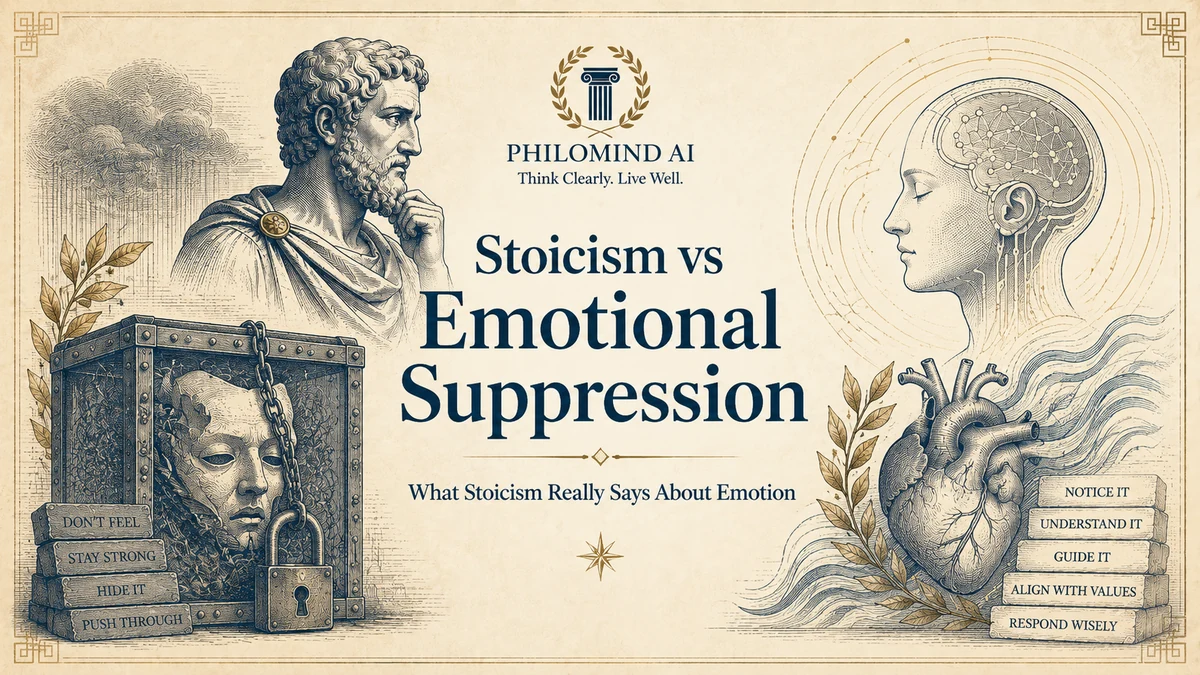
Anger may alert you that a boundary or value has been violated, but it can also add exaggerated judgments and impulses. Marcus Aurelius repeatedly examines the beliefs that lead people to wrongdoing and warns himself not to become unjust in response.
The practical task is neither immediate discharge nor silent concealment. Name the wrong accurately, allow enough distance to choose a proportionate response, and act in a way you could still defend after the emotional intensity changes.
11. Losing motivation
Stoicism does not require feeling inspired before acting. Marcus’s reminders about duty and common benefit show a different sequence: identify the work that belongs to your role, begin it, and let motivation follow disciplined engagement when it does.
This is not a command to ignore exhaustion. Rest, health, and sustainable limits are normally reasonable things to choose. The question is whether “I do not feel like it” is useful information about a real limit or a temporary impression being treated as an order.
12. Living with a problem that cannot be quickly solved
Some problems are chronic, institutional, relational, or simply slow. The Stoic contribution is not a claim that attitude makes the problem harmless. It is a way to prevent the unresolved problem from determining every judgment and action.
You can continue to seek change, accept help, revise plans, and protect what matters while recognizing that today’s agency may be smaller than your desired outcome. The measure becomes the quality of the available response, not possession of complete control.
Practical or modern example
Imagine that a promotion goes to a colleague after months of work. A non-Stoic first reaction might still occur: disappointment, anger, embarrassment, or fear. Stoicism does not require denying these reactions.
A disciplined review separates the event from added claims:
- Event: another candidate received the promotion.
- Interpretations to test: “My work has no value,” “I will never progress,” or “Everyone sees me as inferior.”
- Actions available: request useful feedback, document achievements, correct weaknesses, discuss the decision process, apply elsewhere, or revise the goal.
- Outcomes not commandable: the manager’s judgment, the colleague’s reputation, and the next opening.
- Character question: can the response remain honest, just, and courageous without pretending the disappointment is pleasant?
The exercise does not guarantee success. It prevents one outcome from deciding every conclusion about the future.
Questions to explore
- Which part of your current problem is fact, and which part is judgment?
- What action remains yours even if the result cannot be guaranteed?
- Are you using acceptance to avoid responsibility, or to face reality more clearly?
- Which external result has become a verdict on your worth?
- What would a just response look like after the strongest emotion has passed?
- Which repeated thought is shaping the character you are becoming?
How PhiloMind AI approaches this topic
PhiloMind AI currently offers separate source-grounded AI interpretations inspired by Marcus Aurelius and Epictetus. Marcus is framed around duty, perspective, social conduct, and steadiness under pressure. Epictetus is framed around judgment, agency, impressions, and what remains up to your choice. They are not presented as the historical people and should not be flattened into one generic Stoic voice.
You can explore the Stoic AI experience or browse the current philosophers. Philosopher debates are now live through Debate Mode for debate-ready philosophers.
Sources and further reading
The structured source records accompanying this article identify the approved primary passages and scholarly references used during drafting. The modern examples are editorial applications, not direct historical quotations, and the full article still requires human philosophical source review before publication.
On this page
Sources
- The Encheiridion, or Manual by EpictetusWork: Enchiridion. Locator: Sections 1, 5, 8, 14, and 20. Source host: Project Gutenberg.
- The Discourses of Epictetus by Epictetus, as recorded by ArrianWork: Discourses. Locator: I.1; I.17; I.28; II.5; III.2. Source host: Perseus Digital Library.
- The Meditations by Marcus AureliusWork: Meditations. Locator: II.1; II.11; IV.3; V.16; IX.42; X.11; XI.18; XII.3. Source host: MIT Internet Classics Archive.
- Stoicism by Marion Durand, Simon Shogry, and Dirk BaltzlyWork: Stanford Encyclopedia of Philosophy. Locator: §§1, 2.9, and 4.1–4.7, especially §4.7 on passions. Publisher: Metaphysics Research Lab, Stanford University. Published 2023.
- Marcus Aurelius by Rachana KamtekarWork: Stanford Encyclopedia of Philosophy. Locator: §§1–4, especially the discussion of Meditations, deliberation, and ethical practice. Publisher: Metaphysics Research Lab, Stanford University. Published 2025.
AI assisted with research organization and drafting. The article requires human editorial and philosophical source review before publication.
PhiloMind AI provides source-grounded AI philosopher conversations and live Debate Mode between debate-ready philosophers.