What Is Socrates AI? Can AI Really Use the Socratic Method?
Socrates AI can model disciplined questioning, but it cannot recover the historical Socrates. A responsible system must work through Plato and other witnesses, disclose uncertainty, and distinguish source-grounded inquiry from impersonation.
On this page
Socrates AI is a conversational system designed to examine claims through questions inspired by Socratic dialogue. It can ask for definitions, test reasons, expose tensions, and encourage revision. It cannot recover the historical Socrates, speak with his consciousness, or guarantee what he would say about a modern problem. The best version is a transparent, source-grounded interpretation of questioning practices represented in ancient witnesses.
The first problem: Socrates wrote nothing
There is no book authored by Socrates that an AI can simply imitate. The surviving evidence comes through other writers, especially Plato and Xenophon, whose portrayals differ. Scholars refer to the difficulty of reconstructing the historical person as the Socratic problem.
This means “Socrates AI” must always contain a qualification. The system can be inspired by Plato’s represented Socrates, by approved passages, and by scholarly accounts of elenchus and examination. It cannot treat a generated answer as a recovered transcript from the fifth century BCE.
A responsible product should make the witness visible. A response grounded in Plato’s Laches is evidence about the questioning practice in that dialogue, not a guarantee that the historical Socrates used identical words in every conversation.
What the Socratic method can mean in an AI conversation
Modern education uses “Socratic method” for several related practices. Plato’s shorter dialogues repeatedly show a question-and-answer examination in which an interlocutor begins with a claim, agrees to further premises, and discovers that the commitments do not fit together.
An AI can model several functions of that process.
Clarifying a definition
A user says, “I need a successful career.” The AI asks what successful means: income, recognition, independence, useful work, excellence, or something else.
The goal is not wordplay. A vague central term can hide several incompatible aims.
Asking for reasons
The user says, “If I turn down this promotion, I am not ambitious.” The AI asks why accepting a promotion is necessary for ambition and whether ambition concerns status, demanding work, or excellence.
Testing implications
If success means public recognition, does an excellent but unknown person fail by definition? If loyalty means never disagreeing, can honest correction ever be loyal?
Producing a counterexample
In the Laches, proposed accounts of courage are tested against cases that reveal they are too narrow or incomplete. A modern AI can use the same function without claiming to reproduce the dialogue exactly.
Identifying contradiction
The user may accept both “A good leader invites criticism” and “A leader who changes direction looks weak.” The conversation asks whether these commitments can be reconciled or whether one requires revision.
Ending in better uncertainty
Socratic dialogue does not always produce a final definition. In the Meno, confidence gives way to perplexity. That result can be productive when it replaces false certainty with a clearer question.
What AI adds—and what it risks
AI makes iterative questioning available on demand. It can remember definitions within the conversation, summarize commitments, generate counterexamples, and adjust the level of difficulty.
The same fluency creates risks. A model can invent a quotation, claim a false historical fact, ask repetitive questions without philosophical purpose, or steer the user toward a hidden conclusion while presenting itself as neutral. NIST identifies confabulation and anthropomorphization as generative-AI risks and recommends verification of sources and citations. UNESCO emphasizes transparency and human responsibility.
The system therefore needs explicit rules:
- never claim literal identity with Socrates;
- identify the relevant witness or work when possible;
- distinguish quotation from paraphrase and interpretation;
- do not present one modern checklist as the only ancient method;
- summarize why a question matters;
- avoid humiliating or manipulating the user;
- leave consequential decisions with the user;
- disclose uncertainty when sources do not settle the issue.
Can an AI really be Socratic?
It can perform Socratic functions, but the word should be used carefully.
An exchange becomes more genuinely Socratic when the questions grow from the user’s own claims, the user remains responsible for answers, and the conversation tests consistency rather than merely supplying a prewritten lesson. It becomes less Socratic when the system asks random questions, hides a predetermined conclusion, or rewards the user for agreeing with it.
The standard is not the number of question marks. It is the structure of examination.
Practical or modern example
A user writes:
I should stay in a secure job because leaving would be irresponsible.
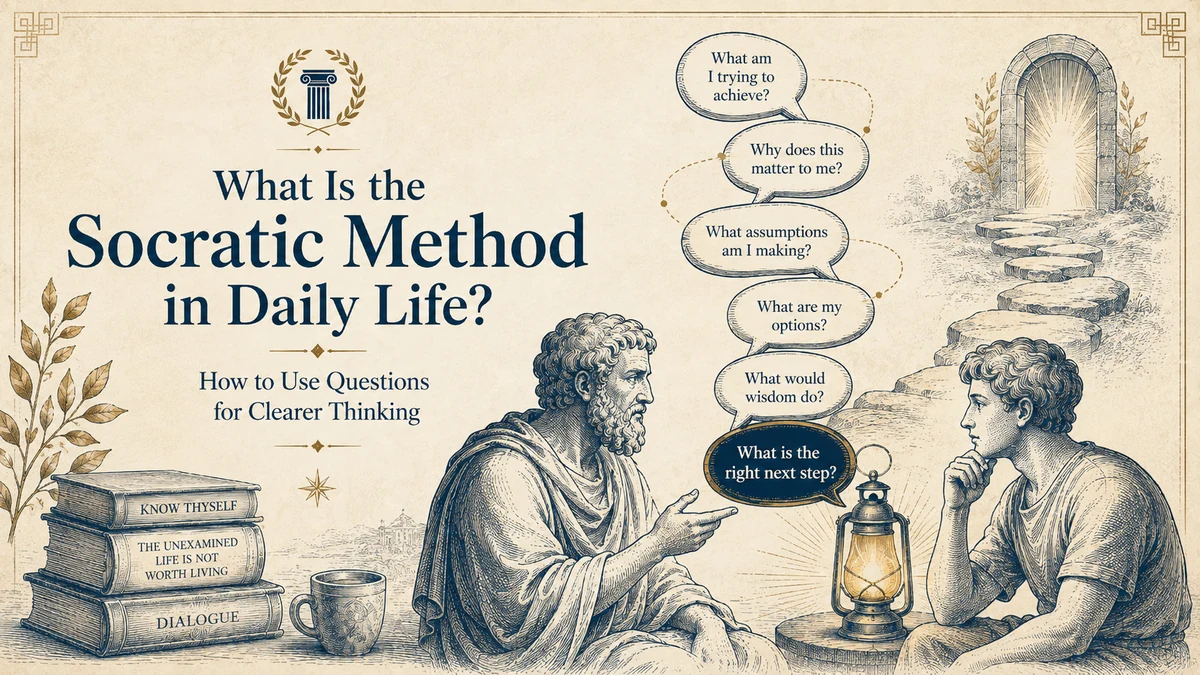
A useful Socrates-inspired sequence might ask:
- What makes a job secure?
- What do you mean by irresponsible?
- To whom do you have responsibilities?
- Does staying always satisfy those responsibilities?
- Can leaving be planned in a way that protects them?
- Would you judge another person by the same rule?
- Which evidence would change your conclusion?
The AI should not decide whether the user must stay or leave. The purpose is to reveal definitions, assumptions, and missing facts so the user can reason more clearly.
How to recognize a weak Socrates chatbot
Warning signs include:
- fabricated ancient quotations;
- absolute claims about what Socrates believed without naming a witness;
- endless questions that never summarize progress;
- insults or humiliation presented as “Socratic toughness”;
- automatic disagreement with everything;
- a claim that questioning itself proves intelligence;
- medical, legal, financial, or therapeutic authority;
- language suggesting the historical Socrates is literally present.
Questions to explore
- Which witness and passage shape the conversation?
- Is the system testing your claim or pushing a hidden answer?
- Has the central term been defined clearly enough?
- Which premises have you accepted?
- What counterexample would challenge your view?
- What remains uncertain after the dialogue?
- Are you using AI to examine a decision or to avoid responsibility for it?
How PhiloMind AI approaches this topic
PhiloMind AI describes its Socrates experience as an AI-generated source-grounded interpretation. The live experience emphasizes definitions, assumptions, contradictions, and self-examination while explicitly stating that Socrates left no writings and that the historical record comes through other authors.
You can explore Socratic AI, browse the current philosophers, or create an account. Debate Mode is now live for debate-ready philosophers.
Sources and further reading
The structured source records accompanying this article identify the Platonic passages, scholarly discussions of the Socratic problem and elenchus, official AI-risk guidance, and current PhiloMind AI product documentation used during drafting. Human source review remains required before publication.
On this page
Sources
- Apology by PlatoLocator: 20c–23c; 37e–38a. Source host: Project Gutenberg.
- Laches by PlatoLocator: 190d–193d. Source host: Project Gutenberg.
- Socrates by Debra Nails and S. Sara MonosonWork: Stanford Encyclopedia of Philosophy. Locator: Introduction and §§1–2, especially the Socratic problem and ancient sources. Publisher: Metaphysics Research Lab, Stanford University. Published 2026.
- Plato’s Shorter Ethical Works by Paul WoodruffWork: Stanford Encyclopedia of Philosophy. Locator: §§1–3, especially §2 on elenchus and dialogue-specific discussions of definition and aporia. Publisher: Metaphysics Research Lab, Stanford University. Published 2024.
- Artificial Intelligence Risk Management Framework: Generative Artificial Intelligence Profile by National Institute of Standards and TechnologyWork: NIST AI 600-1. Locator: §2.2 “Confabulation”; §2.7 “Human-AI Configuration”; actions MS-2.5-003 through MS-2.5-005. Publisher: National Institute of Standards and Technology. Published 2024.
- Recommendation on the Ethics of Artificial Intelligence by UNESCOLocator: Paragraphs 35–38 and 68 on human oversight, ultimate responsibility, transparency, explainability, and accountability. Publisher: UNESCO. Published 2021.
- Socratic AI: Source-Grounded Questioning With Socrates by PhiloMind AIWork: PhiloMind AI product documentation. Locator: Current capability, historical uncertainty, and source-transparency sections. Publisher: PhiloMind AI. Published 2026.
AI assisted with research organization and drafting. The article requires human editorial and philosophical source review before publication.
PhiloMind AI provides source-grounded AI philosopher conversations and live Debate Mode between debate-ready philosophers.