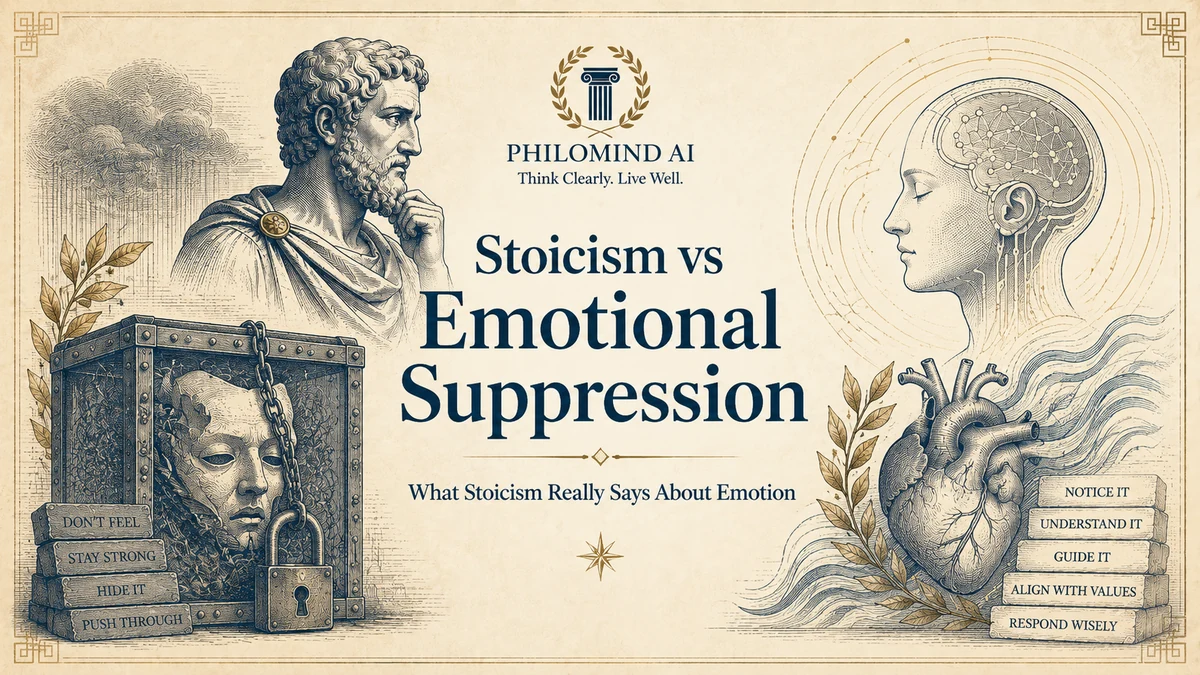
Stoicism vs. Emotional Suppression: Does Being Stoic Mean Hiding Your Feelings?
Stoicism does not simply tell people to hide feelings. Ancient Stoic theory distinguishes initial reactions from judgments and disordered passions, while also recognizing good feelings, social concern, and deliberate action.
On this page
Being Stoic does not simply mean hiding feelings. Ancient Stoics criticize passions understood as excessive impulses shaped by mistaken judgments, but they do not describe the ideal person as a blank or unfeeling machine. Stoic theory recognizes initial reactions that occur before assent, “good feelings” associated with correct judgment, affection for other people, and deliberate expression guided by reason and justice.
Emotional suppression is a modern psychological description, not an ancient Stoic technical term. The comparison must therefore be made carefully and without turning philosophy into medical advice.
Why the stereotype exists
In ordinary English, “stoic” often means showing little emotion under pain. Ancient texts also contain severe claims about freedom from passions. Read without their technical context, these claims can sound like instructions to feel nothing.
Stoic philosophy uses passion more narrowly than everyday speech. The passions are not simply every sensation, mood, or emotional response. They are impulses connected with judgments about good, evil, and appropriate action that the Stoics regard as excessive or mistaken.
For example, fear may involve judging that a future external event is a genuine evil that must be avoided at any moral cost. Anger may involve judging that retaliation is appropriate because another person has harmed something taken to be an unconditional good.
The theory is controversial, but it is not identical to “keep every feeling inside.”
Initial reactions are not the same as chosen judgments
Stoic sources and later reports distinguish reactions that arise before full assent. The modern scholarly label often used is pre-emotions or pre-passions. A sudden sound can startle. Bad news can produce a bodily shock. A face may flush before deliberate reasoning begins.
This distinction matters because it prevents an impossible standard. The practice is not “never feel an initial reaction.” It concerns what happens next: the interpretation, continued mental rehearsal, impulse, and action built around the reaction.
Epictetan practice asks whether the impression should be accepted as it first appears. “I feel afraid” does not automatically prove “The future event is unbearable” or “I must betray my values to avoid it.”
The Stoics also recognize good feelings
The Stanford Encyclopedia of Philosophy notes that Stoic theory includes eupatheiai, often translated as good feelings. This directly challenges the caricature of the sage as an unfeeling robot.
The exact ancient taxonomy is technical, but the larger point is clear: Stoic moral progress is not the removal of every positive attachment, concern, joy, or wish. The philosophy connects human beings through rational and social nature and treats justice and cooperation as central.
Marcus Aurelius repeatedly reminds himself that people are made for cooperation. He does not tell himself to become indifferent to wrongdoing or to other people. He tries to respond without hatred, imitation of the wrong, or surrender of justice.
Suppression and Stoic examination are different processes
Emotional suppression often means attempting to conceal or push away an emotion without examining the belief, need, or situation connected to it.
Stoic examination asks different questions:
- What happened?
- What impression appeared?
- Which judgment did I add?
- Which part of that judgment is true?
- What value or external outcome am I treating as unconditional?
- What response is just and proportionate?
- Does expression serve repair, protection, or clarity?
A person may still decide not to express an emotion immediately, but the reason is not automatically shame about having it. Delay can create space for a more accurate and effective response.
Does Stoicism permit anger?
Ancient Stoics are generally critical of anger as a passion. They do not treat it as necessary for justice. This is stronger than the modern claim that anger can sometimes provide useful information.
A careful modern application can distinguish the recognition of injustice, bodily arousal, and a deliberate commitment to act from a continuing desire for retaliation. You do not need to deny that you are angry. You can ask which judgment is sustaining the anger and whether the planned action protects others or merely discharges hostility.
The article should not pretend that ancient Stoic theory and contemporary psychology use identical concepts. They do not.
Does Stoicism permit grief?
Loss produces reactions that cannot be reduced to a voluntary switch. Stoic texts often recommend remembering mortality and the fragility of externals, but this does not make grief morally shameful by definition.
The philosophical question is how grief develops into judgments such as “Life can no longer contain anything worthwhile” or “Because this loss should not have happened, reality must be rejected.” A Stoic may challenge these judgments while continuing to love, remember, and mourn.
This is philosophical interpretation, not bereavement treatment. People facing severe or persistent distress may need support outside a philosophy app.
Practical or modern example
A colleague takes credit for your work. You feel a rush of anger and humiliation.
Suppression-only response: say nothing, deny the anger, and continue replaying the event privately.
Impulsive response: send an accusation immediately, exaggerate motives, and attack the person’s character.
Stoic examination:
- State the event accurately.
- Identify the judgments: “My reputation is ruined,” “They must be punished,” or “I cannot tolerate this.”
- Decide which values are involved: honesty, fairness, responsibility to the team.
- Choose a proportionate action: document the work, speak directly, correct the record, or use a formal process.
- Refuse to imitate deception while still opposing it.
The Stoic response may be firm and visible. Calm appearance is not the central measure; just and reasoned action is.
When “Stoicism” becomes unhealthy avoidance
A person is misusing Stoic language when they:
- treat every emotion as evidence of weakness;
- use “outside my control” to avoid setting a boundary;
- remain silent about abuse or injustice to appear tough;
- deny bodily or emotional limits;
- shame other people for grief, fear, or distress;
- replace reflection with motivational slogans;
- refuse qualified help because needing it seems “un-Stoic.”
These behaviors are not established by quoting one Stoic sentence. They require ethical and practical evaluation of the whole situation.
A four-part practice that avoids suppression
1. Name the reaction
“I feel anger and embarrassment.” Naming is not endorsement.
2. Separate event and judgment
“The colleague presented my work as theirs” differs from “Everyone now believes I am worthless.”
3. Identify the value and action
What requires protection or repair? Which action is honest, just, and proportionate?
4. Choose expression deliberately
Expression can include a conversation, written record, request, boundary, or decision to wait. The question is not “How do I look emotionless?” but “What response serves the value at stake?”
Questions to explore
- Are you examining an emotion or merely hiding its appearance?
- Which judgment is sustaining the reaction?
- What initial reaction occurred before deliberate assent?
- Which value or boundary needs action?
- Would expression clarify and protect, or only intensify conflict?
- Are you demanding emotional perfection from yourself or someone else?
- What kind of support lies outside the role of philosophy?
How PhiloMind AI approaches this topic
PhiloMind AI offers source-grounded AI interpretations inspired by Marcus Aurelius and Epictetus. The product should not equate Stoicism with numbness, dominance, or emotional concealment. It can help examine judgments and actions while preserving the distinction between philosophical reflection and medical or mental-health care.
You can explore Stoic AI or browse Marcus Aurelius and Epictetus. Debate Mode is now live for debate-ready philosophers.
Sources and further reading
The structured source records accompanying this article identify primary Stoic passages and scholarly discussions of assent, passions, good feelings, pre-emotions, and social action. The comparison with emotional suppression is a modern interpretive framework and requires human philosophical review before publication.
On this page
Sources
- The Encheiridion, or Manual by EpictetusWork: Enchiridion. Locator: Sections 1, 5, 8, 14, and 20. Source host: Project Gutenberg.
- The Discourses of Epictetus by Epictetus, as recorded by ArrianWork: Discourses. Locator: I.1; I.17; I.28; II.5; III.2. Source host: Perseus Digital Library.
- The Meditations by Marcus AureliusWork: Meditations. Locator: II.1; II.11; IV.3; V.16; IX.42; X.11; XI.18; XII.3. Source host: MIT Internet Classics Archive.
- Stoicism by Marion Durand, Simon Shogry, and Dirk BaltzlyWork: Stanford Encyclopedia of Philosophy. Locator: §§1, 2.9, and 4.1–4.7, especially §4.7 on passions. Publisher: Metaphysics Research Lab, Stanford University. Published 2023.
- Epictetus by Margaret GraverWork: Stanford Encyclopedia of Philosophy. Locator: §§1, 3, 4.1, 4.3–4.7, and 5. Publisher: Metaphysics Research Lab, Stanford University. Published 2022.
- Marcus Aurelius by Rachana KamtekarWork: Stanford Encyclopedia of Philosophy. Locator: §§1–4, especially the discussion of Meditations, deliberation, and ethical practice. Publisher: Metaphysics Research Lab, Stanford University. Published 2025.
AI assisted with research organization and drafting. The article requires human editorial and philosophical source review before publication.
PhiloMind AI provides source-grounded AI philosopher conversations and live Debate Mode between debate-ready philosophers.