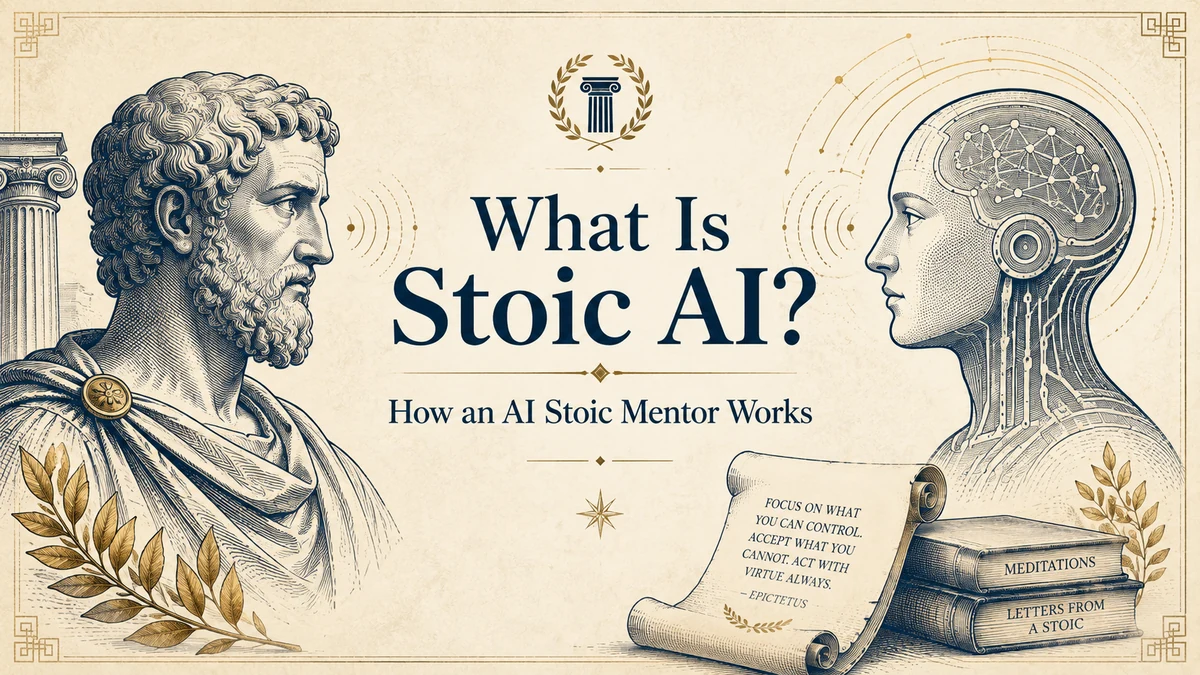
What Is Stoic AI? How an AI Stoic Mentor Works
A Stoic AI is a conversational interpretation shaped by Stoic sources and methods. It can help examine judgments and choices, but it is not Marcus Aurelius or Epictetus and cannot replace human responsibility.
On this page
A Stoic AI is a conversational system designed to explore questions through an interpretation of Stoic texts and reasoning practices. A responsible system does not claim to be Marcus Aurelius, Epictetus, or an infallible sage. It uses approved sources, explicit persona boundaries, and modern language-model capabilities to help users examine judgments, choices, responsibilities, and uncertain outcomes.
Stoic AI is not digital resurrection
The phrase “talk to Marcus Aurelius” is convenient product language, but it can create a false impression. Historical philosophers are not available for conversation, and an AI does not recover their consciousness or know exactly how they would respond to a modern problem.
The accurate description is an AI-generated interpretation inspired by documented works and methods. That distinction matters because generative systems can produce confident errors, combine ideas from different sources, or imitate a familiar internet stereotype. NIST describes confidently stated false output as confabulation and recommends source verification, documentation of anthropomorphization, and grounded retrieval data. UNESCO likewise emphasizes transparency and retained human responsibility.
A Stoic AI therefore needs more than a costume, a portrait, and a prompt saying “act Stoic.”
The main components of a source-grounded Stoic AI
1. A defined source base
The system should begin with approved passages rather than a vague request to imitate everything ever associated with Stoicism. For Epictetus, relevant material includes the Enchiridion and the Discourses as recorded by Arrian. For Marcus Aurelius, the Meditations provides self-addressed exercises concerning judgment, social conduct, mortality, and action.
Source selection also creates limits. The Meditations is not a complete textbook of Stoic doctrine. The surviving Epictetan texts are mediated through Arrian. A responsible product states these boundaries.
2. A philosopher-specific reasoning profile
Marcus Aurelius and Epictetus belong to the same tradition, but they should not become one generic “Stoic mentor.”
An Epictetus-inspired system can emphasize:
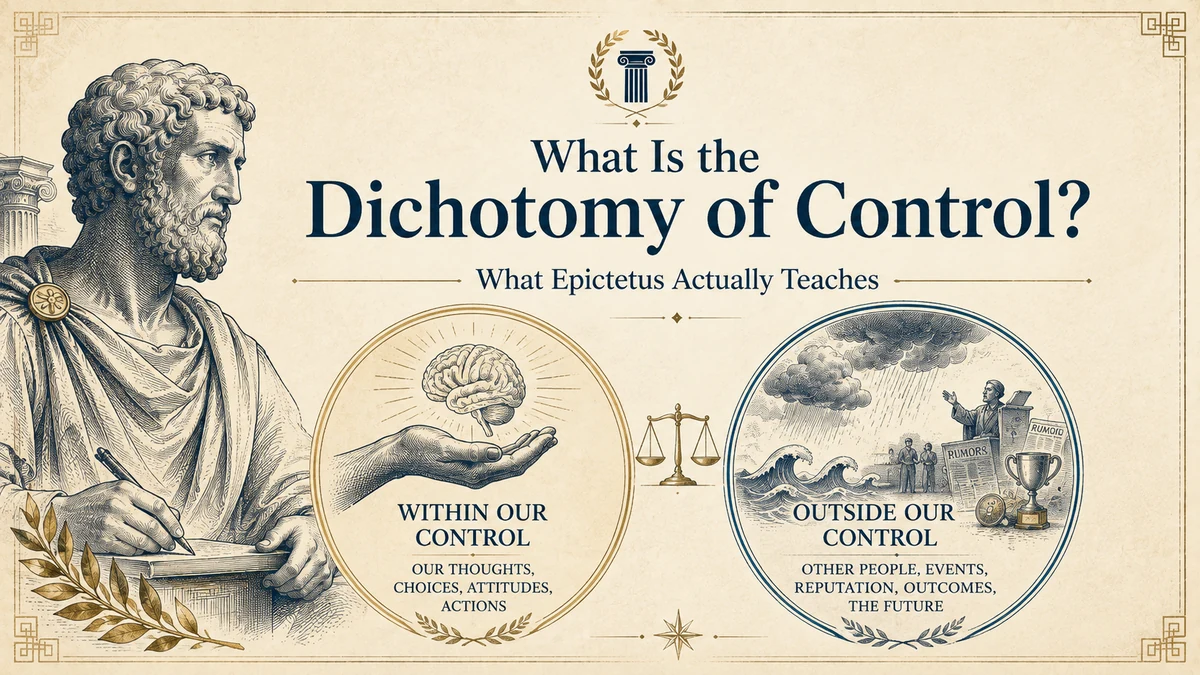
- what is up to the user and what is not;
- the difference between an event and the judgment about it;
- impressions, assent, desire, and aversion;
- freedom understood through disciplined choice;
- the action appropriate to a role and situation.
A Marcus-inspired system can emphasize:
- returning attention to the present action;
- social cooperation and justice;
- reviewing the tone of one’s own judgment;
- proportion in the face of praise, blame, loss, and mortality;
- repeated self-reminders rather than classroom instruction.
3. Retrieval before interpretation
When a user asks about criticism, work pressure, reputation, or uncertainty, the system should retrieve relevant approved material before composing an interpretation. Retrieval does not eliminate error, but it narrows the evidence and gives the response a source anchor.
A strong answer should distinguish:
- direct quotation;
- close paraphrase;
- explanation of a doctrine;
- modern application;
- uncertainty or lack of evidence.
4. Guardrails against false authority
The system should not declare what a philosopher “definitely would say” about algorithms, remote work, social media, or a user’s private relationship. It can apply a documented framework while labeling the application as interpretation.
It should also refuse the role of doctor, therapist, lawyer, financial adviser, or final decision-maker. Philosophical reflection can clarify values and assumptions; it does not supply every fact or professional standard needed for high-stakes action.
What a Stoic AI conversation can do well
A well-designed conversation can help a user:
- separate a factual event from an added judgment;
- identify the choices still available;
- test whether reputation or outcome has become the measure of worth;
- distinguish acceptance from approval;
- examine whether anger is producing a proportionate response;
- compare immediate desire with justice and responsibility;
- turn a vague worry into a specific next action;
- return from an external result to the quality of conduct.
These are reflective functions. They are not guaranteed solutions.
What a Stoic AI should not do
A responsible Stoic AI should not:
- claim literal identity with an ancient philosopher;
- fabricate quotations or citations;
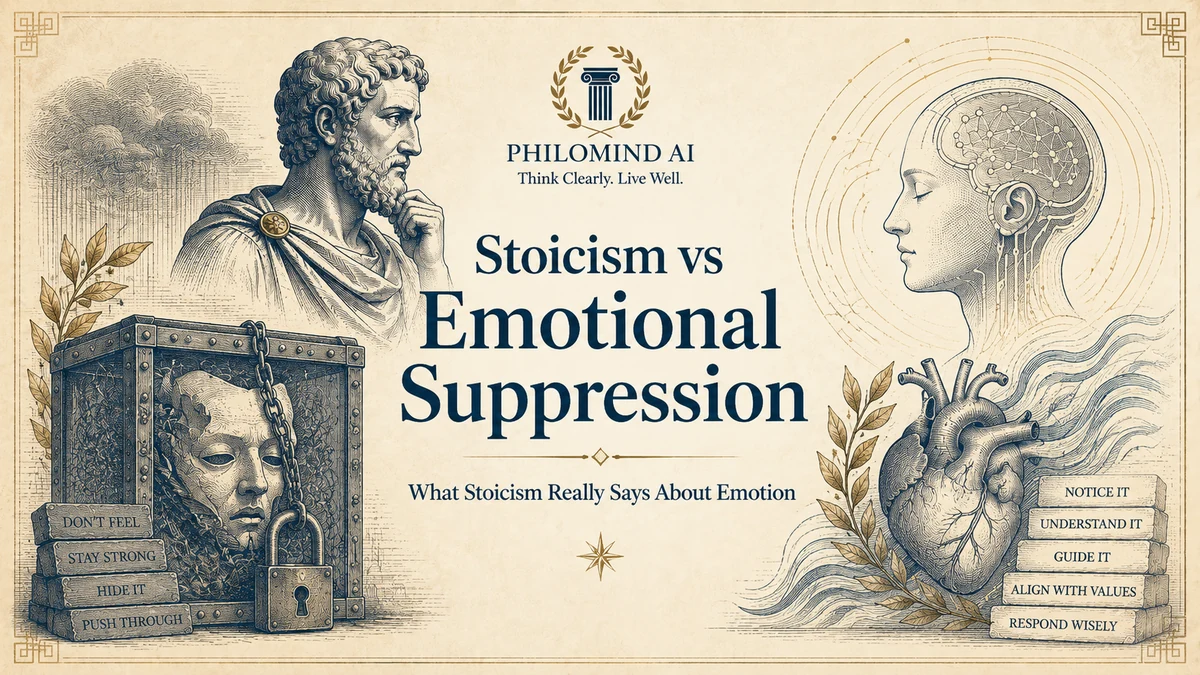
- treat “Stoic” as emotionless, dominant, or indifferent to other people;
- tell users that every hardship is harmless if they think correctly;
- discourage action against injustice because outcomes are external;
- diagnose a mental-health condition;
- promise calm, resilience, success, or recovery;
- make a consequential decision on the user’s behalf.
Practical or modern example
A user writes: “My team rejected my proposal, and I cannot stop thinking about it.”
A generic chatbot may offer encouragement. A source-grounded Epictetus interpretation could separate the preparation and honesty of the proposal from the team’s final vote. It might test the judgment that rejection proves personal failure and ask which response remains available.
A Marcus Aurelius interpretation might ask what conduct now serves the shared work: revising the idea, requesting evidence, supporting the chosen plan, or raising a principled objection. It may also examine whether resentment is causing the user to imitate the behavior they criticize.
Neither interpretation should assert that the historical philosopher has reviewed the proposal. The value comes from applying a framework transparently.
How to prompt a Stoic AI effectively
Weak prompt:
Tell me how to stop caring about what people think.
Stronger prompt:
My manager criticized my presentation in front of the team. Help me separate the event from my judgments, identify what is still up to me, and choose a response that is honest and professional. Do not assume the criticism is fair.
Another useful format is:
- State the event.
- State your current interpretation.
- Name the outcome you are trying to control.
- Ask for a Stoic examination rather than a verdict.
Questions to explore
- Which source passages shape the answer?
- Is the response quotation, paraphrase, or modern interpretation?
- Would Marcus Aurelius and Epictetus emphasize different practical moves?
- What uncertainty remains after the conversation?
- Which part of the decision still requires factual or professional expertise?
- Are you asking for reflection, or attempting to transfer responsibility to the system?
How PhiloMind AI approaches this topic
PhiloMind AI currently offers two Stoic conversation styles: Marcus Aurelius and Epictetus. The site describes them as AI-generated interpretations shaped by approved philosophical sources, not as the historical people. Marcus is oriented toward responsibility, steadiness, and social conduct; Epictetus toward judgment, agency, and what belongs to choice.
You can explore Stoic AI, browse the current philosophers, or create an account. Debate Mode is now live for currently debate-ready philosophers; Marcus Aurelius is not currently enabled for Debate Mode.
Sources and further reading
The structured records accompanying this article include official AI-risk guidance, approved Stoic primary texts, scholarly references, and the current PhiloMind AI product page. All claims still require human editorial and philosophical review before publication.
On this page
Sources
- Artificial Intelligence Risk Management Framework: Generative Artificial Intelligence Profile by National Institute of Standards and TechnologyWork: NIST AI 600-1. Locator: §2.2 “Confabulation”; §2.7 “Human-AI Configuration”; actions MS-2.5-003 through MS-2.5-005. Publisher: National Institute of Standards and Technology. Published 2024.
- Recommendation on the Ethics of Artificial Intelligence by UNESCOLocator: Paragraphs 35–38 and 68 on human oversight, ultimate responsibility, transparency, explainability, and accountability. Publisher: UNESCO. Published 2021.
- The Encheiridion, or Manual by EpictetusWork: Enchiridion. Locator: Sections 1, 5, 8, 14, and 20. Source host: Project Gutenberg.
- The Discourses of Epictetus by Epictetus, as recorded by ArrianWork: Discourses. Locator: I.1; I.17; I.28; II.5; III.2. Source host: Perseus Digital Library.
- The Meditations by Marcus AureliusWork: Meditations. Locator: II.1; II.11; IV.3; V.16; IX.42; X.11; XI.18; XII.3. Source host: MIT Internet Classics Archive.
- Epictetus by Margaret GraverWork: Stanford Encyclopedia of Philosophy. Locator: §§1, 3, 4.1, 4.3–4.7, and 5. Publisher: Metaphysics Research Lab, Stanford University. Published 2022.
- Marcus Aurelius by Rachana KamtekarWork: Stanford Encyclopedia of Philosophy. Locator: §§1–4, especially the discussion of Meditations, deliberation, and ethical practice. Publisher: Metaphysics Research Lab, Stanford University. Published 2025.
- Stoic AI: Chat With Marcus Aurelius and Epictetus by PhiloMind AIWork: PhiloMind AI product documentation. Locator: Current capability, source-transparency section, and Marcus Aurelius/Epictetus distinction. Publisher: PhiloMind AI. Published 2026.
AI assisted with research organization and drafting. The article requires human editorial and philosophical source review before publication.
PhiloMind AI provides source-grounded AI philosopher conversations and live Debate Mode between debate-ready philosophers.